
Peasants to Puddles
My Family History - By Nicky Rowberry
William Burns Gemmell - Private 3150
This page is dedicated to the memory of William Burns Gemmell who died on 17th April 1918.
William Burns Gemmell died on 17th April 1918 in Folkestone, England. He was unfortunately one of the casualties amongst the millions of men who lost their lives in World War 1. It seemed sad for him to have died and all but these bare facts remembered, so I've tried to find out at least a little about his life before his untimely death aged just 27.
William Burns Gemmell was born in 1891 at Balgownie, New South Wales, Australia. For some reason although he was named William, he was known as Jerry by friends and family alike. He was the 4th of 5 known children of Allan Wark Gemmell and his wife Esther (nee Burns). Allan & Esther were Scots who had emigrated to Australia in the late 1880s. Back in Scotland Allan had been a coal miner; as there was a coal mine in Balgownie, it's possible he continued in this line of work in Australia. I've not been able to find much out about William's life before the war, but one newspaper article did suggest he'd worked at Hebburn colliery, so it sounds as if he followed in his father's footsteps and went down the mines.
War broke out in the summer of 1914, when William would have been about 23 years old. The Commonwealth War Graves Commission website confirms that he was a Private in the 45th Battalion of the Australian Infantry and that his service number was 3150. I can't reproduce his CWGC record, but to see his page please click here.
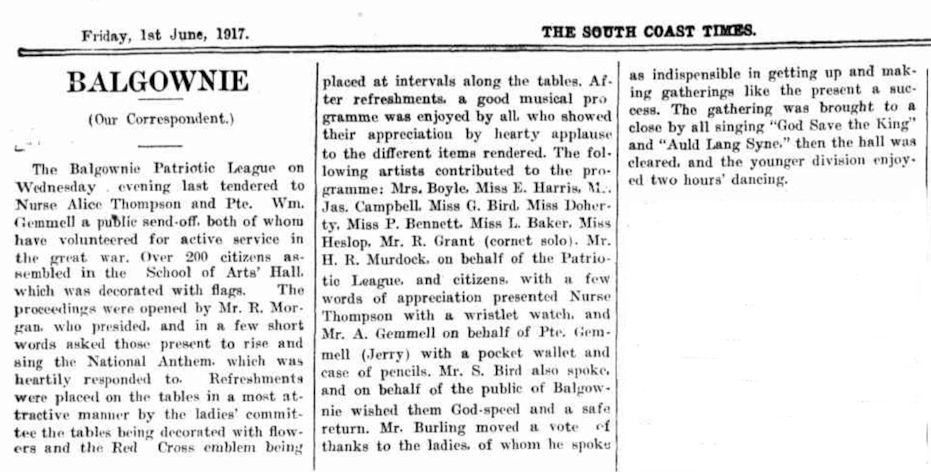
Fortunately the Australian service records from WW1 have survived and are now available online. They show that William enlisted on 27th October 1916 at Wollongong, when he was 25 years and 7 months old. At the time of his attestation, he was working as a miner. Within a month he had embarked from Sydney on the HMAT Beltana, arriving in England at the end of January 1917. Unfortunately he arrived in England already sick, it was slight at first but had developed into bronchitis by March 1917. He had recovered sufficiently by May 1917 to be posted to France with his unit. News of his posting much have reached back home as the Balgownie Patriotic League gave him (and Nurse Alice Thompson who was also on active service) a send off at a local hall. His father accepted a pocket wallet & set of pencils on his behalf - items he may never have received, unless his father was able to post them to him.
The 45th Battalion fought in the Battle of Messines in June 1917. The Australian War Diaries for the 45th Battalion show that by October 1917, William's battalion was on the French/Belgian border around Zonnebeke and that there was heavy shelling of the troops that day. They were caught up in the notorious Passchendaele battle as part of the Ypres offensives of 1917. William was wounded in action on 11th October 1917 and was sent back to England also suffering from exhaustion and trench foot.
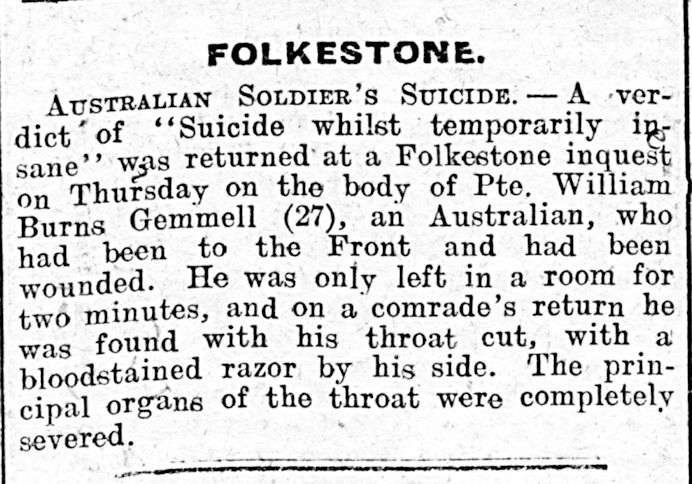
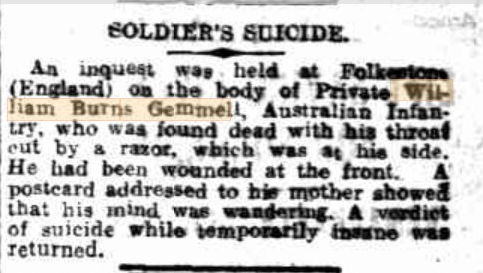
William spent the next few months being moved around various military hospitals in England, before ending up in Folkestone in April 1918. He died on 17th April 1918 when he cut his own throat with a razor. The coroner's inquest the following day concluded that he died by "cutting his throat with a razor while temporarily insane". He left a postcard written to his mother, that was barely coherent, but stated that "the military sent him to France to be wilfully murdered".
He was buried in Shorncliffe Military Cemetery in Folkestone. It was a full military funeral with the coffin draped in a Union Jack and a band, firing party and buglers playing "The Last Post". Hopefully this was some small comfort to his parents that he was given full military honours at his funeral. Today he is also commemorated on the Australian War Memorial in Canberra as well as the local memorial in his home town of Balgownie and at the Balgownie Presbyterian Church.
His service records also state that William would have been entitled to the British War Medal and the Victory Medal as he served in an operational theatre of war. His parents would also have received a Memorial scroll and plaque for their son.
William's death was reported in the newspapers, both in the UK and back home in Australia. The image below is taken from the Kentish Gazette on 20th April 1918. Image created courtesy of THE BRITISH LIBRARY BOARD. Image reproduced with kind permission of The British Newspaper Archive (www.britishnewspaperarchive.co.uk)
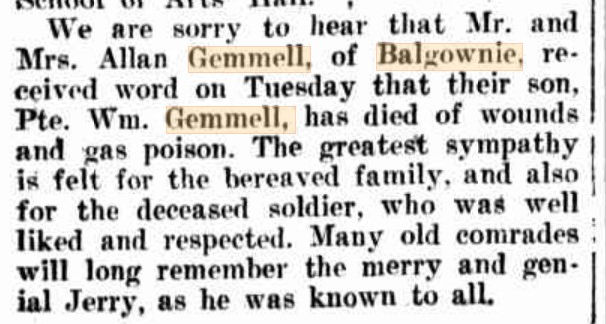
The one below is from the Newcastle Morning Herald & Miners' Advocate 1st May 1918.
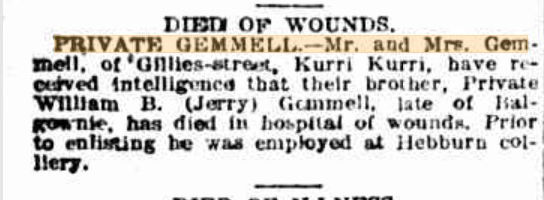
Whether these reports were made to spare his parents' feelings or whether the full news of his death had just not reached home in the early days, is not clear. But later in the summer the Australian newspapers reported his death more accurately, as in this one from the Daily Herald, Adelaide on 6th July 1918.
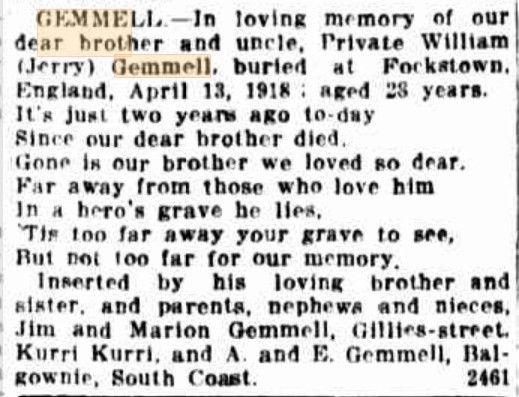
His family remembered him 2 years after his death with this report in the Newcastle Morning Herald & Miners' Advocate in April 1920, with a similar one in 1921.
His mother Esther was granted a war pension of £1 per fortnight; it must have been a sad reminder every fortnight of her loss. It seems likely that William was suffering from Post-Traumatic Stress Disorder (PTSD) probably brought on by the things he had suffered out in France. These days his struggle would hopefully have been recognised and he would have received the help he desperately needed, but in WW1 little was understood about the mental toll the war took on the soldiers. His is one of the most tragic stories I have researched from WW1; such a waste of a young man's life.
So far I don't have a photograph of William. The best I can manage is the brief description of him from his service records. He was apparently 5 foot 3 inches tall and weighed just 9 stone. He had a fair complexion, with grey eyes and fair hair. It would be lovely to be able to add a photograph to complete his story, so if anyone has a photo of William Burns Gemmell, please do get in touch. E-mail: n.rowberry@btinternet.com
In researching William's life, several sites have been invaluable, so I've included links to some of them here.
Beth Page's wonderful website remembering Australian Soldiers and Nurses from WW1 who rest in the UK. She has a page dedicated to William Burns Gemmell which can be found here.
The Commonwealth War Graves Commission:

The National Archives at Kew:

The British Newspaper Archive:

The Australian War Memorial website gives lots of information on Australian soldiers who died in WW1 (and other conflicts).

The National Library of Australia is a fantastic online resource for, amongst other things, digitised newspapers and images. 



If any of the above is of further interest, please feel free to contact me at: n.rowberry@btinternet.com
Nicky Rowberry 2026
Thank you for visiting my site. You are visitor number:
Peasants to Puddles - My Family History. By Nicky Rowberry